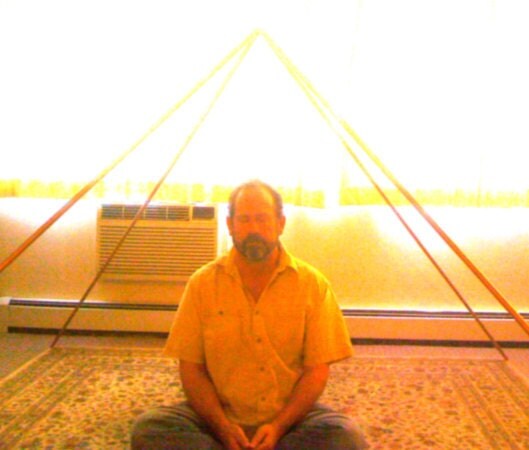
Meditation Pyramids
I have been meditating under pyramids for over twenty years. I began in 1988, stringing copper wire from the ceiling to the hardwood floor, stapling or taping it there copying the dimensions of the Great Pyramid of Giza. I was in Brooklyn, NY in an apartment there. Crystal healing and new age ideals had become a global phenomenon at this time which some might attribute to the harmonic convergence. At any rate, I soon began building my own meditation pyramids out of copper pipe.

Pyramids for Healing
From my first experience with these pyramids it was incredible. They offer a sacred and safe space for sensitive individuals to meditate, relax and heal. It was one of these individuals and was amazed at the difference inside the pyramids. I was able to focus more deeply with this electromagnetic barrier between myself and the barrage of thought-forms that I experienced otherwise. Whether these forms were directed towards me or simply randomly hitting me, I can not tell you. Inside the pyramid I was free from this barrage. I was able to process things that were specific to myself alone which allowed me to heal– psychically, emotionally, mentally, and what must have also been physically.
Building Copper Pyramids
Over the years I have built a number of them, experimenting with sizes, angles, components, etc. In 2001, I built an enormous one on a back porch (built to hold the pyramid) in Northern California. Sides and base were all out of one-inch heavy copper pipe, and the I even bent a plate of copper to form the capstone (as pipes obviously do not form a point when brought together). I can tell you now that size, weight, capstone, and even pipes at the base made little difference energetically. I can say that now, as my design has improved, culminating in around 2006, when I build my first portable and collapsible meditation pyramid.
Copper Pyramids for Meditation (Portable)
Tired of losing my pyramid every time I moved, or having to assemble and disassemble it constantly, I decided to experiment with building one that I could both easily put away in a closet, but could also keep if I needed to move again. So, the design you see below was born. It was not long meditating under these copper pyramids before it became clear that they were going to be just as effective as any previous. What matters most is the side pipes and the angles they form.
Meditation Pyramids for Sale
I posted a do-it-yourself video, wanting to share these with others who may be interested, offering to build them myself and shipping them out for any who did not feel up to the task. It was not long before I was selling them on Etsy (see the shop advertisement, right). As of this post, it has been just less than a year and I have built over twenty pyramids for others. The design works. There is no need for a capstone, and the copper electrical wires at the base are more than enough to hold the space.

Personal Development
I have experienced my kundalini rise from base to crown. I have grounded myself to the degree where I can walk about in my daily life and deflect negative energy with compassion without taking it into my energetic space. I can function in a healthy way in relationships because of my contact with source and my clarity of myself as an individual and sacred being. I owe so much of this to my experiences communing and confiding with myself under these meditation pyramids. I recommend them to anyone who is dealing with any of the above issues.
Here is the link to my Etsy shop: Copper Pyramids for Meditation, Healing and here is the link to do-it-yourself instructions at my blog on meditation pyramids at Meditation Pyramids Blog”
 About Adam: Adam Tebbe is editor at Sweeping Zen, an online resource which has biographies and interviews with various Zen teachers throughout the world. He began his Zen practice in 2002 and is founder of Kannonji Zen Retreat, an outreach of Sweeping Zen in the virtual world of Second Life. The temple hosts weekly events with Zen clergy like Rev. Jay Rinsen Weik and Rev. Paul Dochong Lynch, as well as special events with other Buddhist teachers throughout the year. He is also partner, with David Sango Angstead, at DharmaPixels, a web design & development company that helps organizations and nonprofits develop their presence on the web.
